

Daniel Ek, the CEO of Spotify, is doubling down: After an initial investment of €100 million in Helsing, a German start-up company specialising in AI military software, his investment firm, Prima Materia, is leading another investment of €600 million into the company. Now, Ek is also named chairman of Helsing.
And where is the money coming from? Simple: You, the paying Spotify subscriber. On the back of doling out pennies on the dollar to musicians, even demonetising a majority of music on the platform, and mass layoffs.
In May 2025, Music Business Worldwide reported that Ek has now cashed out more than $800 million in Spotify stock. The money now fuels the development of AI-powered drones, aircrafts, and submarines, and a new ‚Centaur‘ system that will integrate „advanced AI pilots“ into the cockpits of fighter aircrafts.
The implementation of AI in warfare brings a tidal wave of ethical questions to the already convoluted subject of war. In 2024, Kristian Humble wrote in the Georgetown Journal of International Affairs:
It is uncertain whether the ethical or moral questions surrounding conflict driven by algorithms and machines without human intervention can ever be answered. The use of automated drones, which are not weapons themselves but rather platforms to deliver weapons, is not specifically regulated under international law. […] The international community must establish an international legal framework that ensures humans always retain meaningful control over autonomous weapons systems and that systems do not select military targets during conflict autonomously.
And Queen Mary University of London’s Dr Elke Schwarz notes that „we don’t want to get to a point where AI is used to make a decision to take a life when no human can be held responsible for that decision.“
If you work in music and want to follow how these developments play out closer to home, Sound Business is our monthly Swiss music industry briefing. Independent, analytical, no mere press releases.
Leverage the Supply Side
Navigating the software landscape as a consumer has generally become a tricky moral tightrope walk. However, Spotify’s ethical failures have been well-documented: abysmally low royalty payments, platforming misinformation and rampant misogyny, bot infestations, and AI-generated content taking over real artists’ profiles.
Its hyperscaling growth attempt contributed significantly to the devaluation of music, although one could argue that it was an inevitable scenario with digitisation’s disruption of traditional gatekeepers.
 Janosch Troehler
But now, there’s an undeniable connection between Spotify’s abusive business model and its profit to an AI weapon manufacturer via the person of Daniel Ek. Without ripping off the creativity of artists, his investment wouldn’t have occurred.
Sadly, the music industry will have to face this challenge and cannot rely on customers to make the decision. People will flock to the most affordable and convenient options, with the majority hardly considering the ethical implications.
The only lever here is the supply side.
The Artist’s Dilemma
For newcomers and musicians in the early phases of establishing themselves, Spotify has, at least financially, essentially nothing to offer. The only reason is discoverability, and the hope that the algorithm picks your music for one of its generated playlists. But there, you’ll compete with AI-generated slop designed to fit the mould and created in seconds. With no proper editorial representation in Switzerland, taking the human-curated route seems even harder. You could also enter Spotify’s Discovery Mode pay-for-play scheme with a questionable and unclear outcome.
Understandably, musicians want to be where the people are. And currently, that’s Spotify. However, if the trends continue on their current trajectory, neither financial success nor discoverability will be a sustainable and promising reason to remain on Spotify.
It would be career suicide to ditch Spotify.
As long as the industry doesn’t come together to define new metrics for success untethered to Spotify, musicians face the dilemma alone, potentially jeopardising their careers. Should I Stay Or Should I Go?
Aryan Ashoori, label manager at London outlet Outtallectuals, told Resident Advisor that it „would be career suicide“ to ditch Spotify. „I don’t agree with what they’re doing, but it’s not a personal decision,“ Ashoori told Resident Advisor. „We represent about 150 different artists, and I wouldn’t be able to pull the plug on behalf of so many people either.“
A consolidated and coordinated effort is necessary. The now irreversible problem is that the music industry at large made Spotify the unignorable behemoth it is today, and you could argue that it is also their responsibility to take it down again.
However, Spotify suddenly changing its ways seems highly unrealistic, and Daniel Ek might just funnel more money out of the business to fuel his endeavours in the military-industrial complex, thanks to the works of artists. I want to believe that this is contrary to the ethical beliefs of the majority of musicians.
Especially with the rise of artificially generated sound (let’s not call it music), the time seems right to build a sustainable, verified human-only offer, while moving away from Spotify and letting the soulless AI slop eat it.
Redirect Attention
While ditching Spotify as an artist or label might not be viable in the short term, there are still immediate actions that can be taken to slowly move away from the platform and redirect the community’s attention. For example:
- Invest no money in Spotify marketing.
- Providing early access to new music via paid downloads on Bandcamp or the band’s store.
- Using alternative services instead of Spotify to highlight new releases.
- Building potentially monetizable community spaces, such as newsletters or profiles on services like Patreon or Fanclub.
 Janosch Troehler
Ultimately, it comes down to the economics of each individual artist. How likely is it for you to reach such a massive following on Spotify that streaming leads to substantial revenue? And how likely is it to build a smaller, yet highly engaged community elsewhere, where you’ll have complete control?
Follow Through?
We are currently witnessing a rise in activism among musicians, particularly in response to the horrific humanitarian situation in Palestine. Also in Switzerland, some artists like Black Sea Dahu are vocal about it and regularly call for their followers to interact with their posts, as Meta shadowbans the reach of profiles that voice their opinions (a whole other topic we don’t have time to get into here).
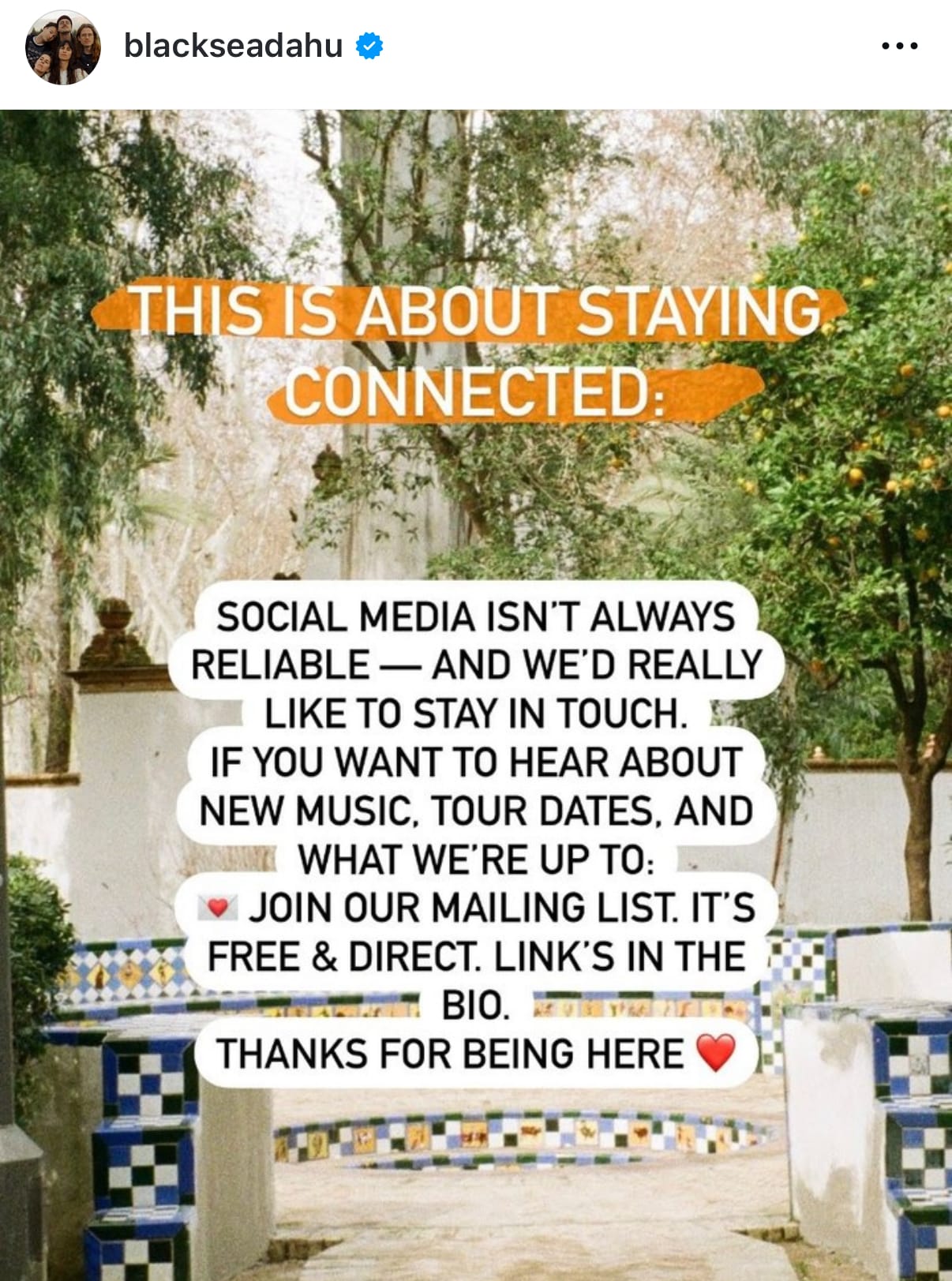
I’m curious if and how these already vocal artists will encounter this situation now, one that is impacting them far more directly. How will they reconcile their ethical and moral convictions with the reality of Spotify’s indispensable industry power?
There could also be a potential interplay between activist musicians and their communities. Cultivating an equally activist community which has a lower barrier to move away from Spotify might ease the way for the artist, too. But for now, this remains only a hypothesis.
Sound Business covers the Swiss music business monthly: venue closures, policy, streaming economics, and what it means for people working in music.


